

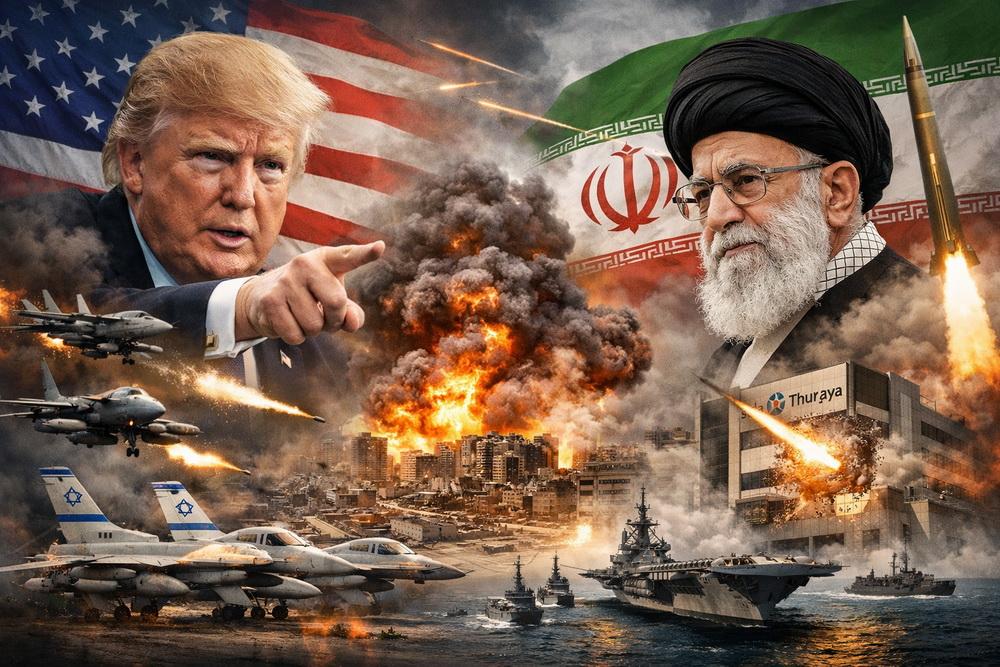
Washington/Tehran: Tensions between the United States and Iran have sharply escalated, with strong military warnings, ongoing airstrikes, and growing fears of a wider regional conflict, as global leaders urge restraint.
Trump’s Ultimatum and Regime Change Remarks
US President Donald Trump has issued a dramatic warning to Iran, suggesting that a critical turning point in global history may be imminent. He cautioned that failure to comply with US demands could lead to catastrophic consequences, even warning that an entire “civilisation” could be at risk if the situation spirals out of control.
Trump indicated that a regime change in Iran could be a possible outcome of the confrontation, arguing that such a shift might bring about more pragmatic leadership and end decades of what he described as corruption, coercion, and violence. At the same time, he expressed hope that a peaceful resolution could still be achieved.
Threats of Massive Military Action
In a more direct escalation, Trump threatened that the US could cripple Iran’s infrastructure within hours, including targeting power plants and key bridges. He warned that the country could face overwhelming military action if Tehran failed to reopen the strategically crucial Strait of Hormuz within the specified deadline.
Iran, however, dismissed these statements as “arrogant rhetoric,” maintaining that such threats would not influence its decisions or actions.
Airstrikes and Missile Exchanges Intensify
Meanwhile, the situation on the ground has continued to deteriorate. Israeli forces have reportedly launched a new wave of airstrikes targeting Iranian positions, while activating air defence systems in response to incoming Iranian missiles.
Explosions have been reported in Tehran and nearby Karaj, signalling an intensification of hostilities and raising concerns of a broader conflict involving multiple regional actors.
US Signals More Options on the Table
US Vice President JD Vance stated that while Washington has already achieved many of its military objectives, it still possesses additional options that have not yet been deployed.
He emphasized that the US is leaving room for diplomacy but warned that further action could be taken if Iran does not alter its course. Vance expressed cautious optimism that negotiations could still prevent further escalation before the US-imposed deadline expires.
Conflict Reaches Gulf Region
In a concerning development, the conflict appears to be spilling beyond Iran and Israel. Authorities in Sharjah confirmed that a ballistic missile launched from Iran struck an administrative building belonging to a telecommunications company in the emirate’s central region.
Two Pakistani nationals sustained moderate injuries in the incident and were hospitalized. Officials have urged the public to avoid spreading unverified information and rely only on official updates.
Global Concerns Rise
The rapidly evolving situation has heightened fears of a full-scale war in the Middle East, with potential implications for global energy supplies, especially given the strategic importance of the Strait of Hormuz.
Diplomatic efforts are expected to intensify in the coming hours, as the international community closely watches whether negotiations can prevent further escalation or if the crisis will move toward a wider and more destructive conflict.